
01The project
A mid-sized specialty prepared foods manufacturing facility producing frozen specialty items (ready meals, entrees, sauces, and related products) generated high-strength process wastewater from cooking, mixing, equipment washdown, CIP (clean-in-place), and floor cleaning. The wastewater was high in fats, oils & grease (FOG), total suspended solids (TSS), biochemical oxygen demand (BOD), and chemical oxygen demand (COD). The facility needed reliable pretreatment to meet municipal sewer discharge limits, reduce surcharges, and protect downstream biological treatment.
Pan America Environmental supplied a complete pretreatment train consisting of:
- GTI Grease Trap Interceptor (primary FOG and coarse solids capture)
- ChemClear CT coagulation / pH adjustment / flocculation system
- PD Series Plate Dissolved Air Flotation (PDAF / PDHR or PDHF) system
02The wastewater
Composite sampling and jar testing established the following average/peak ranges:
| Parameter | Inlet Concentration (mg/L) | Notes |
|---|---|---|
| FOG | 400 – 1,300 (avg. ~700) | High free + emulsified oils from cooking oils, sauces, and product residues |
| TSS | 800 – 2,500 (avg. ~1,400) | Food particles, starch, proteins, vegetable matter |
| BOD₅ | 1,000 – 4,000 (avg. ~2,500) | High organic load from carbohydrates, proteins, and fats |
| COD | 3,000 – 8,000 (avg. ~5,000) | |
| pH | 5.5 – 9.5 (variable) | Acidic from product, alkaline from CIP chemicals |
| Flow | 50 – 150 GPM average; peaks to ~200 GPM | Intermittent production shifts |
03Treatment train & equipment
GTI-1650 – Commercial high volume FOG removal
Primary gravity/hydromechanical interceptor sized for peak flow. Captures free-floating FOG, screens out/retains larger settleable solids upstream of the EQ, chemical and flotation stages. Reduces loadings on downstream equipment and prevents large grease accumulations.
Wastewater fed from a below grade collection sump. Incoming water temperature is 110° - 120°F typically and the GTI maintains an operator determined separation zone temperature of 125°F +/- to keep FOG in a liquid state for ease of skimming and gravity fed from the tank to a heated and insulated 1,000-gallon storage tank provided next to the GTI.
EQ Tank
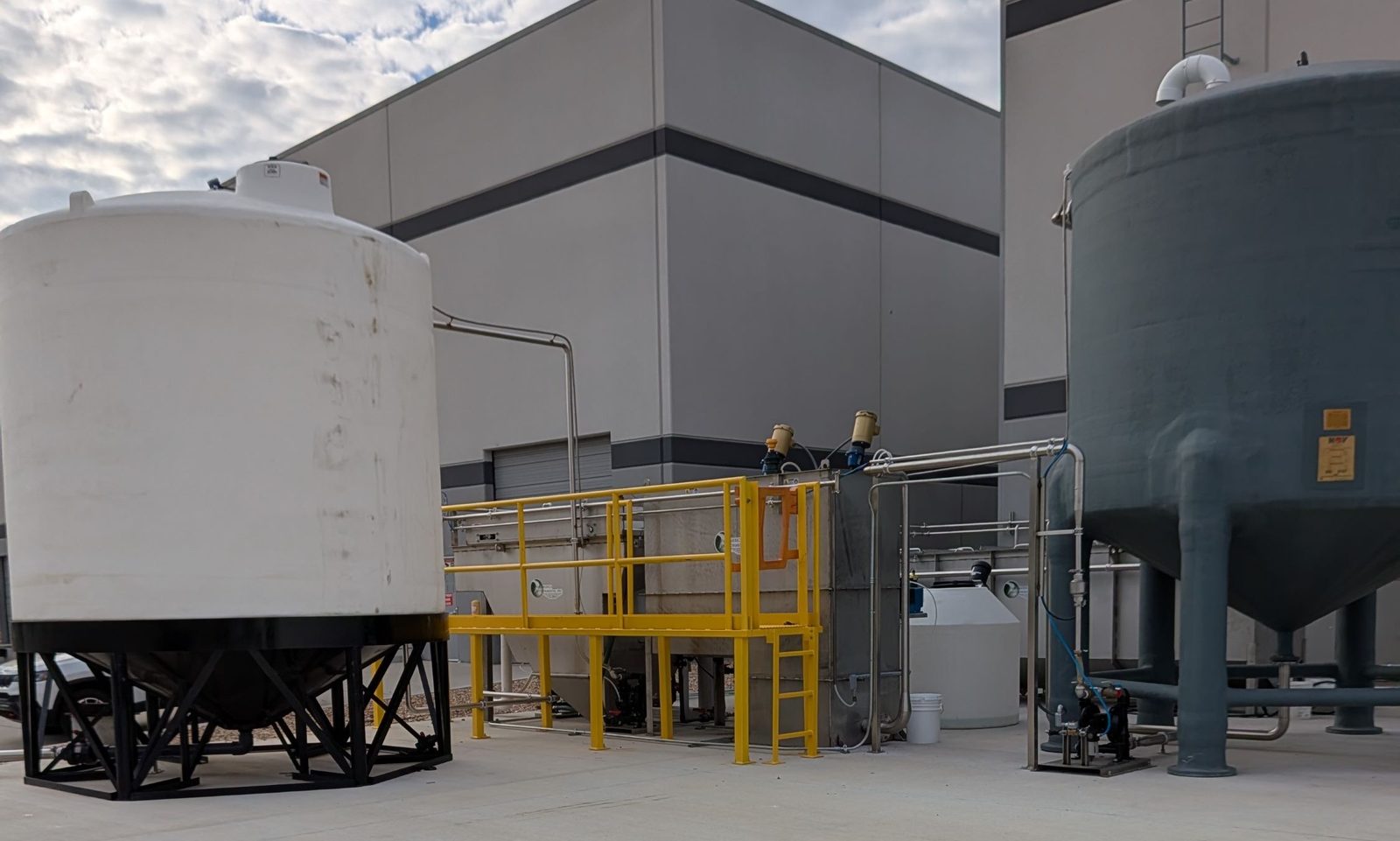
For collection of FOG/TSS reduced wastewater a 5,000-gallon FRP EQ tank was provided to collect treated production water from the GTI throughout the day and facilitate consistent flow metering to the Chemical treatment/DAF systems.
ChemClear CT System (CT Series – Coagulation / pH / Flocculation)
Two-stage sequential reaction tanks (coag/pH + flocculation CT-CpF configuration) with:
- pH adjustment (caustic metering)
- Coagulant dosing aluminum chlorohydrate (others can be PAC, Ferrics, metal salts or organic coagulants)
- Polymer/flocculant addition of cationic polymer
Jar testing optimized chemistry for the specific waste stream (high FOG and colloidal organics). Retention times typically 5 – 8 minutes depending on reaction stage. System includes metering pumps, mixers, and controls. Optional STAX inline flocculation available for space constraints.
PD-50 Series Plate Dissolved Air Flotation
Inclined lamella plate pack (55°) increases effective surface area, promotes laminar flow, and allows higher hydraulic loading in a compact footprint. Recycle Saturation System (RSS) generates microbubbles (10–50 µm). Surface skimmer removes float; sludge hopper collects settled material. Construction includes 304/316 stainless steel. Flow capacity matched to plant (commonly 30–50+ GPM range for this application). Seamless integration with upstream ChemClear CT.
Sludge & FOG Handling
The Owner preferred to store the sludge to have it hauled and so PAE provided a 5,000-gallon cone bottom tank with water phase dewatering valving to allow removal of accumulated water.
The collected FOG is being hauled by secondary market vendors where the Owner can recoup costs by charging for these oils.
04Controls & sensors
The treatment facility is controlled and monitored via our Intell-i-Touch controls platform, which includes our standard Unitronics UniStream controller and 10” touchscreen. Also provided: pH datalogging, Ethernet connection, on screen coagulation and flocculation makeup utilities for simplified solution makeup calculations, on screen pH sensor calibration video and many other functional features to make the Intell-i-Touch platform user friendly.
To monitor system overall health and function numerous sensors such as ultrasonic level, flowmeter, pressure, pH, temperature, energy monitoring, VFD monitoring, motor condition monitoring are provided.
05Results
| Parameter | Inlet (avg.) | Effluent (typical) | Approximate Removal |
|---|---|---|---|
| FOG | 700 mg/L | < 50–100 mg/L | 90–95%+ |
| TSS | 1,400 mg/L | < 50–150 mg/L | 90–97% |
| BOD₅ | 2,500 mg/L | 500–1,200 mg/L | 50–70% (phys/chem only; further biological reduction possible downstream) |
| COD | 5,000 mg/L | 1,500–3,000 mg/L | 50–70% |
| pH | Variable | 6.5–8.5 | Neutralized |
Performance depends on proper chemical conditioning, consistent operation, and sludge management. The PD Series routinely achieves high TSS and FOG removal; COD/BOD reductions are significant for particulate and colloidal fractions but soluble organics may require downstream biological treatment if stricter limits apply to local POTW discharge limits.
Results & benefits
- Consistent compliance with local sewer ordinances and reduced municipal surcharges.
- Compact footprint suitable for existing plant constraints (lamella plates and modular design).
- Reliable FOG capture protecting sewers and reducing maintenance.
- Automated operation with Pan America Intell-i-Touch controls and monitoring options.
- Scalable and containerizable for future expansion or relocation.
- Float and sludge suitable for further dewatering (e.g., belt press or centrifuge) and disposal/recovery.
Note: Actual performance requires site-specific sampling, jar testing, and pilot confirmation. Pan America Environmental provides design, manufacturing, and support for these integrated systems.
06Equipment supplied
- GTI-1650 grease trap interceptor
- Heated and insulated 1,000-gallon storage tank
- 5,000-gallon FRP EQ tank
- ChemClear CT-CpF two-stage chemical treatment (caustic, coagulant, cationic polymer)
- PD-50 Series Plate DAF with RSS recycle saturation system
- 5,000-gallon cone bottom sludge tank
- Intell-i-Touch controls (Unitronics UniStream controller, 10” touchscreen)
- Level, flow, pressure, pH, temperature, energy, VFD and motor condition sensors
07Have a similar project?
Every system we build starts with the water. Send us your flow rate and what is in it, or ask about lab testing to prove the chemistry first.
Download this case study (PDF)
Published October 27, 2026